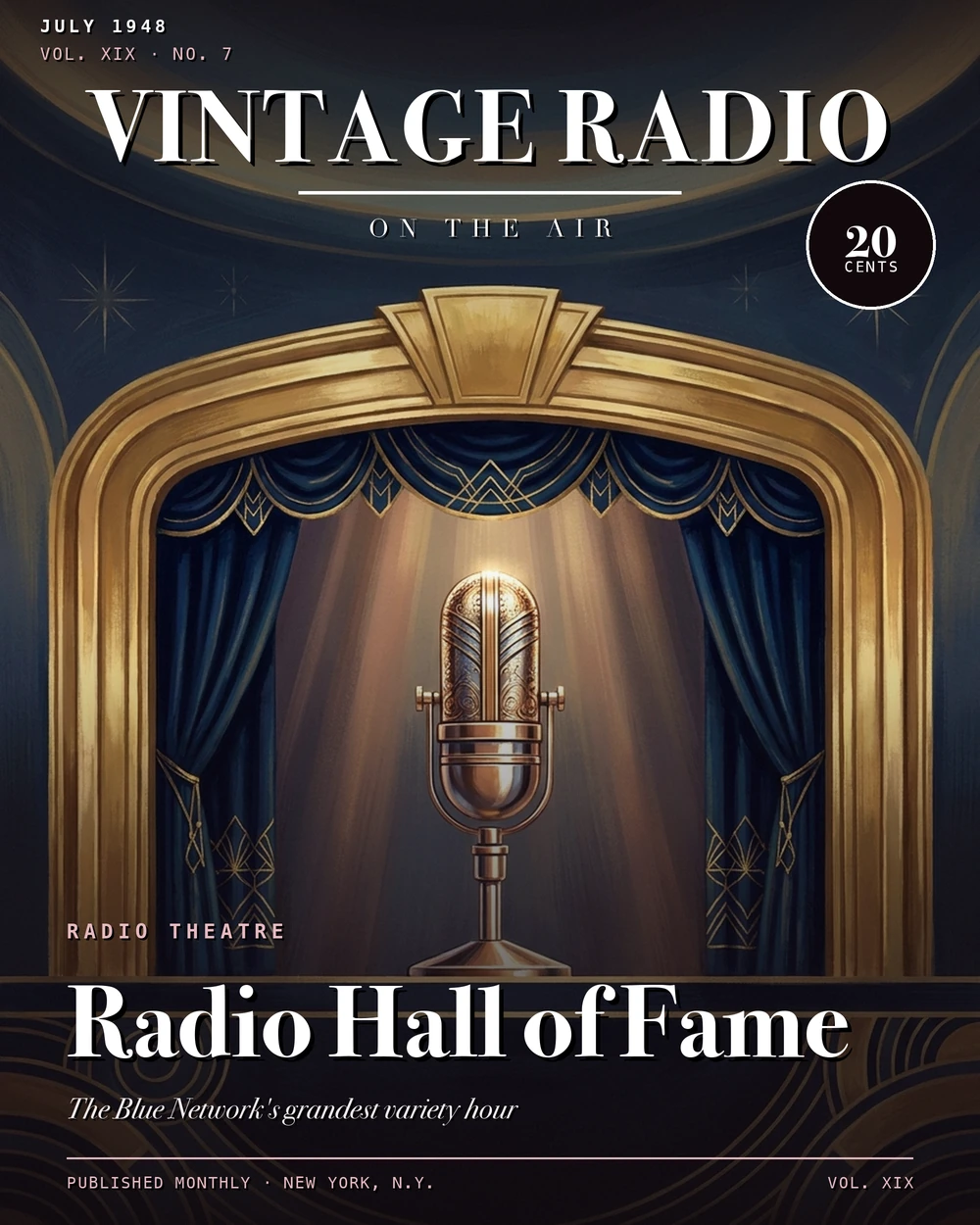
Radio Hall of Fame
The Idea Behind It
The Radio Hall of Fame launched on December 5, 1943, with a premise that was either inspired or problematic depending on where you stood: Variety, the entertainment trade paper, would function as a weekly awards committee, selecting the performers it judged worthy that week and inviting them to appear in an all-star hour of music, drama, comedy, and news. Think of it as a rolling Academy Awards broadcast, with the honorees performing live rather than just collecting a trophy. Sponsored by Philco and broadcast on the Blue Network across 109 stations simultaneously, it was the Blue's only attempt at a full-hour, major-league variety show with big-name guest stars.
The premiere opened and closed with comedy from Jimmy Durante and Bob Hope, with chanteuse Hildegarde, newsman Quentin Reynolds reporting on the fighting fronts, boogie-woogie pianist Maurice Rocco, and an excerpt from the Broadway production Winged Victory filling out the hour. It was a sprawling, ambitious broadcast — and it set the tone for what the show would attempt every Sunday at six o'clock for the next two and a half years.
Behind the scenes, Philco had reportedly budgeted $1.5 million for the program. The production ran out of New York, with director Devere Joseph (Dee) Engelbach overseeing the weekly logistics, writers George Faulkner and Milton Geiger handling the scripts, and Paul Whiteman conducting a 31-piece orchestra. The theme music was titled "The World Outside."
The Conflict Nobody Could Ignore
From the moment the arrangement was announced, critics raised an obvious question: could a newspaper whose entire business was reviewing show business honestly evaluate its own performers? Each Monday, Engelbach met with Variety editors, who chose the talent for that week's broadcast. A booking agency then lined up the performers. The result was that Variety was, in effect, selecting performers and then reviewing them — a circular relationship that made a lot of people uncomfortable.
Ben Bodec, a Variety reporter of fifteen years, quit in protest over the conflict-of-interest arrangement. Variety editor Abel Green defended the show's editorial independence directly, saying, "Jimmy Durante may conceivably louse up the air tomorrow, and we're going to say so." Critics took that defense with a grain of salt. Time, Incorporated, which owned a 12.5% stake in the Blue Network in 1943, and Billboard magazine — Variety's direct trade-paper rival — both had competing promotional interests in the proceedings, which only added to the tangle.
The whole arrangement never quite escaped the shadow of that original criticism. Whether or not Variety actually compromised its reviews, the perception that it might was enough to keep the question alive throughout the show's run.
Why Philco Chose the Blue Network
The choice of the Blue Network as the show's home wasn't random — it grew out of a corporate grudge that went back more than a decade. Philco had been in a bitter dispute with RCA over radio tubes since 1930, and by the early 1940s its ill feelings toward RCA and its owned network, NBC, were still very much alive. By the time the war began, Philco had become the nation's leading manufacturer of home and auto radios, outselling RCA by more than two to one. Spending $1.5 million on an NBC program was not something Philco's management was inclined to do.
The Blue Network's leadership knew this. President Mark Woods and executive vice-president Edgar Kobak were well aware of Philco's animosity toward RCA and deliberately used it to secure the sponsorship. The Blue itself was in transition during this period — it had been sold to Edward J. Noble, the owner of Life Savers candy, for $8 million on October 12, 1943, just weeks before the show's premiere, and it formally became the American Broadcasting Company in mid-1944 while the Radio Hall of Fame was still on the air.
Despite the corporate muscle behind it, the show struggled in the ratings. It finished the 1943–44 season in 111th place with a Hooper rating of 5.4, behind CBS's Silver Theater (7.8) and Mutual's First Nighter (5.9). At 6:30 p.m. on NBC, The Great Gildersleeve was pulling a dominant 16.1. The Sunday six o'clock slot was not kind to the program.
The People Who Made It Sound That Way
Deems Taylor, the show's host, was one of the more distinguished figures radio could have put in front of a microphone in 1943. Born in New York City on December 22, 1885, Taylor was a composer, radio commentator, music critic, and author. He had already served as intermission commentator for the New York Philharmonic broadcasts and appeared as the on-screen host and narrator of Walt Disney's 1940 film Fantasia. Fellow Algonquin Round Table member Nat Benchley described him as "the dean of American music." While hosting the Radio Hall of Fame, Taylor was simultaneously serving as president of ASCAP, a position he held from 1942 to 1948.
Paul Whiteman, the musical director, brought the 31-piece orchestra its authority. Born in Denver on March 28, 1890, Whiteman had earned the nickname "King of Jazz" for popularizing a symphonic jazz style in the 1920s and 1930s, and by the mid-1940s had earned more money than any other conductor in America. He had disbanded his own orchestra in the summer of 1942 when World War II depleted his personnel to military service, then came aboard as musical director for the Blue Network in September 1943 — the same month the Radio Hall of Fame was being organized. His assistants on the show included choir master Robert Shaw and conductors Alfred Newman and Joseph Littau.
Shaw, who had founded the Collegiate Chorale in 1941 — notable in its day for its racial integration — had been named America's greatest choral conductor by the National Association of Composers and Conductors in 1943, the very year the show launched. In its later run, singer Martha Tilton — known professionally as "Liltin' Martha Tilton" and a former featured vocalist with the Benny Goodman Orchestra from 1937 to 1939 — became a regular singing presence. Tilton had recorded for Capitol in 1942 with Paul Whiteman, giving the two a working relationship that predated the show.
What Came Across the Air
The roster of performers the show assembled over its run reads like a survey of mid-1940s American entertainment. Featured appearances included Groucho Marx, Lauritz Melchior, Fred Allen with his entire radio company, Sophie Tucker, Paul Muni, Eddie Cantor, Bing Crosby, George Burns and Gracie Allen, Raymond Gram Swing, and the Andrews Sisters. Helen Hayes appeared in her stage play Harriet. Jennifer Jones and Charles Bickford appeared in The Song of Bernadette, with score and orchestration by Alfred Newman. Agnes Moorehead performed a condensed version of her celebrated Suspense role in Sorry, Wrong Number. Dick Powell served as host on at least one 1945 episode, and Betty Hutton, Jack Haley, Tallulah Bankhead, and Henny Youngman were among the other performers who came through.
A May 21, 1944 broadcast celebrating I Am An American Day brought together Bob Hope, Jane Froman — in her comeback broadcast following her February 1943 plane crash off Portugal while entertaining Allied troops — Jackie Gleason, the Art Tatum Trio, and Cornelia Otis Skinner performing her monologue "Times Square." A week later, on May 28, 1944, Eddie Cantor performed "We're Having a Baby, My Baby and Me" in its entirety after NBC television censors had cut his audio during a TV broadcast of the same song. Philco, angered by the censorship, had invited Cantor to perform the piece uncut on the Blue Network the following Sunday.
Howard and Shelton of It Pays to Be Ignorant turned up in subsequent weeks. The format remained consistent throughout: comedy, music, drama, and news, all backed by the full orchestra and a large chorus.
How It Ended
The show ran at 60 minutes through 1943 and most of 1945, then was cut to 30 minutes in its final period — a sign that the program's original ambition was contracting. Engelbach had already left in 1944, moving on to produce and direct programs including Rogue's Gallery, Academy Award Theater, Hallmark Hall of Fame, and The Big Show. The last broadcast aired on April 28, 1946.
The ratings never reflected the caliber of talent the show was able to attract. The Blue Network's position in the landscape, the complications of the Variety editorial relationship, and the difficult Sunday timeslot all worked against it. What the Radio Hall of Fame did accomplish, at its best, was to put a remarkable collection of mid-decade American performers in one place week after week — drama, comedy, music, and news together, supported by one of the most accomplished production teams the era could assemble.